Free Upgrade on Day 3: A $650 VR Headset Doubles Its Panels and Battery Mid-Campaign
On day 3 of a crowdfunding campaign, the team announced: panels upgraded from 1600x1600 to 2160x2160, battery enlarged from 45Wh to 85Wh, same price, and everyone who already pledged gets the upgrade automatically.
How long has it been since you saw that? In an era when Kickstarter has made us used to downgrades, delays and disappearances, a small Japanese team did the opposite.
What Happened
Walker Industries, a small VR team in Japan, launched their Vector Gear platform on Kickstarter on October 17. The star is the $650 Andromeda headset. On October 20, they published the upgrade announcement — the scene described above.
The platform has three configurations: the $980 Vector Gear, standalone plus PC VR; the $650 LCD Andromeda, PC VR only; and the $1,250 OLED Andromeda with 2560x2560 pancake optics. All three follow one philosophy: buy it, open it, modify it, repair it.

Reading the spec sheet, you'll find the team's thinking is unconventional. Dual 2160x2160 LCD panels at 90Hz, behind combined Fresnel optics they call "pseudo-pancake." The main chip is a Snapdragon 8cx Gen 3 with 8GB of RAM — laptop-class silicon. Beside it sits an RK3588S co-processor with another 8GB, dedicated to SLAM, sensor fusion and wireless PC streaming.
Seven cameras: two monochrome for SLAM, two global-shutter for passthrough, two inward-facing for eye tracking, and one pointed at your mouth.
The battery is an 85Wh Amprius silicon cell. For context: Valve's newly released Steam Frame carries 21.6Wh. This cell is four times that. Storage starts at 500GB NVMe. Each controller carries its own RK3576 and does inside-out tracking.
Weight is unpublished; the team's own words in the October 19 update were that they "can't really determine a weight yet." Field of view is listed: 105 degrees for the Vector Gear and LCD version, 95 for the OLED.
The Open Source Part Is Real, So Far
The most interesting thing about this team isn't the hardware. It's the software stack.
YuukOS, an Arch-based XR distribution. XRUIOS, their own spatial layer. AstroSLAM, their own tracking. Shinra Meisin, their own face tracking, streaming over OSC into VRChat. The timing is uncanny: VRChat just moved face tracking into its official SDK in open beta, and the new system still accepts OSC feeds. x86 emulation runs on FEX, Windows games on Proton, and one team member has contributed to Monado, the open-source tracking framework.
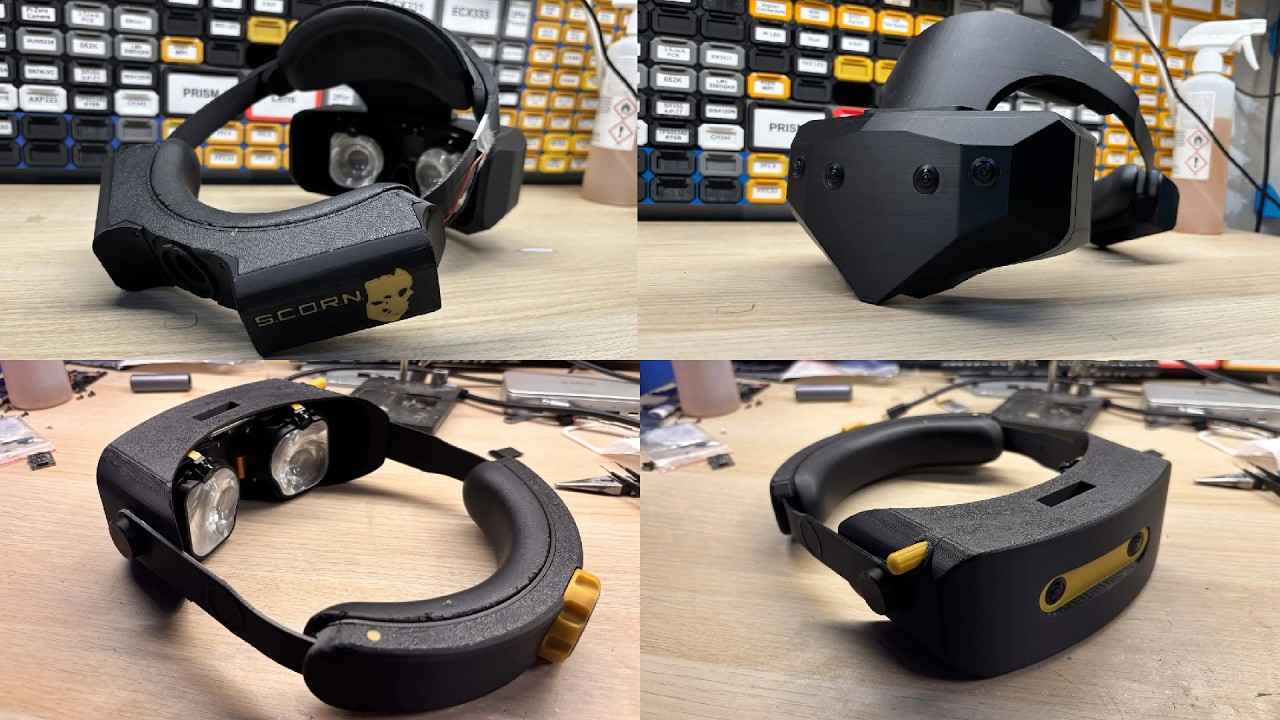
The company promises the platform will be "either source-available or fully open source," opened in stages after release: software first, then parts of the hardware, then most of the headset design. Their GitHub organization is already public. Most parts can be bought individually, with commercial use allowed.
Compare that with Valve. Valve published CAD files and a 44-pin front-port pinout for the Steam Frame, and the industry applauded. But Valve's license is non-commercial only. What Walker Industries is selling is exactly the part Valve withheld: hardware documentation, lens design, commercial rights.
Of course, all of this is still a promise. Their Shinra Meisin repository currently reads "All rights reserved."
The Money Problem
Now the cold math.
As of October 24: $35,820 pledged from 45 backers, against a $150,000 goal — under 24 percent funded. Deadline December 16, 60 days, all or nothing. Delivery: May 2027.
If it funds, they must go from injection-molded shells to production boards in five months. That is a short runway for a first-time Kickstarter team. Veteran VR writer Antony Vitillo, reviewing the project, named Lynx and Tilt Five — both crowdfunded VR cautionary tales — as the right reference class.
Pricing-wise, the Andromeda isn't cheap. 2160x2160 per eye at $650, while Meta Quest 3 does 2064x2208 at $599.99 with standalone capability. The Andromeda's differentiation is the 85Wh battery and openness.
But all-or-nothing means backers pay nothing if it fails. Kickstarter's own page warns that funded campaigns still aren't guaranteed to deliver. Lynx is the example.
My Take
A spec sheet on a crowdfunding page is a wish list. Only the money in the bank is a promise.
What makes this project worth watching isn't the battery. It's whether "open source VR hardware" gets a second chance. After Lynx collapsed, the industry assumed this road was closed. Walker Industries seems to have skipped reading that verdict and put an entire homegrown software stack and open hardware plan on the table anyway.
24 percent funded, 50-plus days to go.
Would you bet on a headset that promises to be open? Let's talk in the comments.
分享文章
3篇相关文章
37 Minutes, One Dead Cat, and an International VR Film Grand Prize
2026-10-26
While everyone else uses VR to make shooting games, Japanese director Jun Wada made a film about loss and healing — and swept awards from Venice to Kaohsiung.
VR Tactical Shooter Geronimo: When Virtual Death Teaches Real-World Communication and Collaboration
2026-07-27
Steam just launched a VR tactical shooter called Geronimo—aimed at squad tactical combat, rough around the edges but gets the core right.
Nurses Must 'Face Violence' Before Internship: How This University Uses VR to Teach Self-Protection
2026-06-16
Australia First: UTS Makes VR Violence Prevention Training Mandatory for Nursing Students