
NVIDIA + Apple: This Cloud Computing Revolution is Breaking XR's Ten-Year Curse
What happens when NVIDIA's RTX GPU power meets Apple's Vision Pro spatial computing?
The answer was just revealed at NVIDIA GTC 2026: visionOS will natively support NVIDIA CloudXR.
This isn't just a simple technical collaboration. The computing power dilemma that has plagued the XR industry for ten years may finally be broken by cloud computing.
XR Industry's Ten-Year Curse
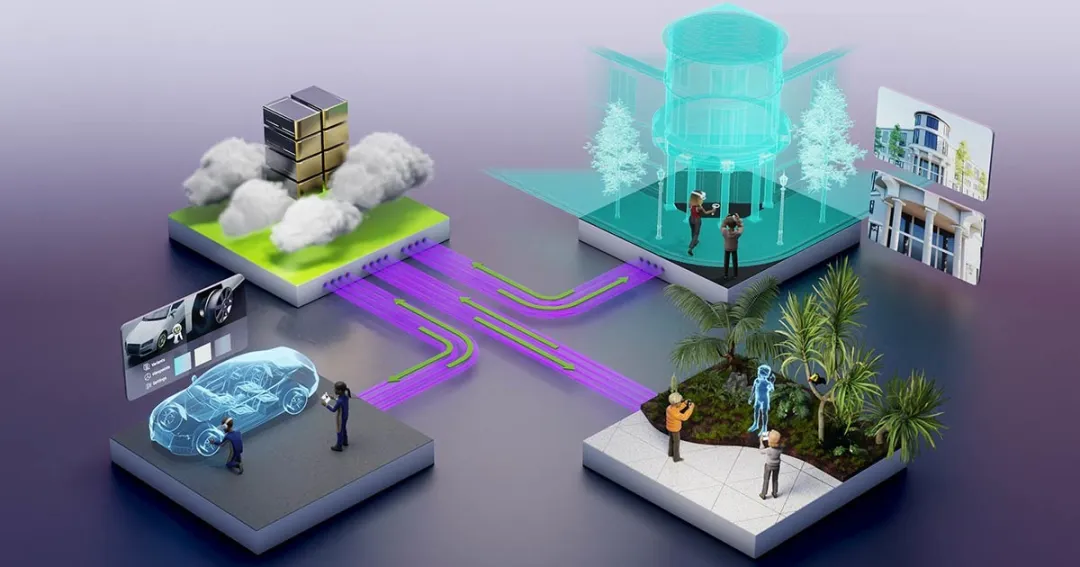
For the past decade, the XR industry has been trapped by a core contradiction: to get high-quality immersive experiences, you need workstation-level computing power; to keep devices lightweight and wearable, you have to sacrifice performance.
It's a dead-end cycle.
Industrial-grade 3D modeling, flight simulation, surgical training, large-scale digital twins—these applications require far more computing power than all-in-one headsets can handle.
Developers face a dilemma: either create "castrated" apps limited by mobile computing power, or abandon lightweight design and return to the PC VR era, dragging a cable and carrying a "computer bag."
That's why high-end XR applications have long relied on PC VR architecture, unable to truly go wireless, lightweight, and mobile. That's why Vision Pro, despite having top-tier display and interaction capabilities, still can't run those computing-intensive AAA titles.
CloudXR: Putting the "Brain" in the Cloud, Keeping the "Eyes" in Front of You
What is NVIDIA's CloudXR?
Simply put, it runs the most computing-intensive rendering on cloud or PC-based RTX GPUs, then streams the rendered images to your headset in real-time.
This isn't ordinary screen mirroring, but a low-latency, high-fidelity graphics streaming solution optimized specifically for XR scenarios.
At GTC 2026, NVIDIA released CloudXR 6.0, with the biggest highlight being deep integration with visionOS.
Zero Configuration, Plug and Play
CloudXR 6.0 deeply embeds into visionOS with a native Swift framework, supporting direct development, debugging, and distribution via Xcode, with no need for third-party relay tools—automatic direct connection.
Dynamic Foveated Streaming
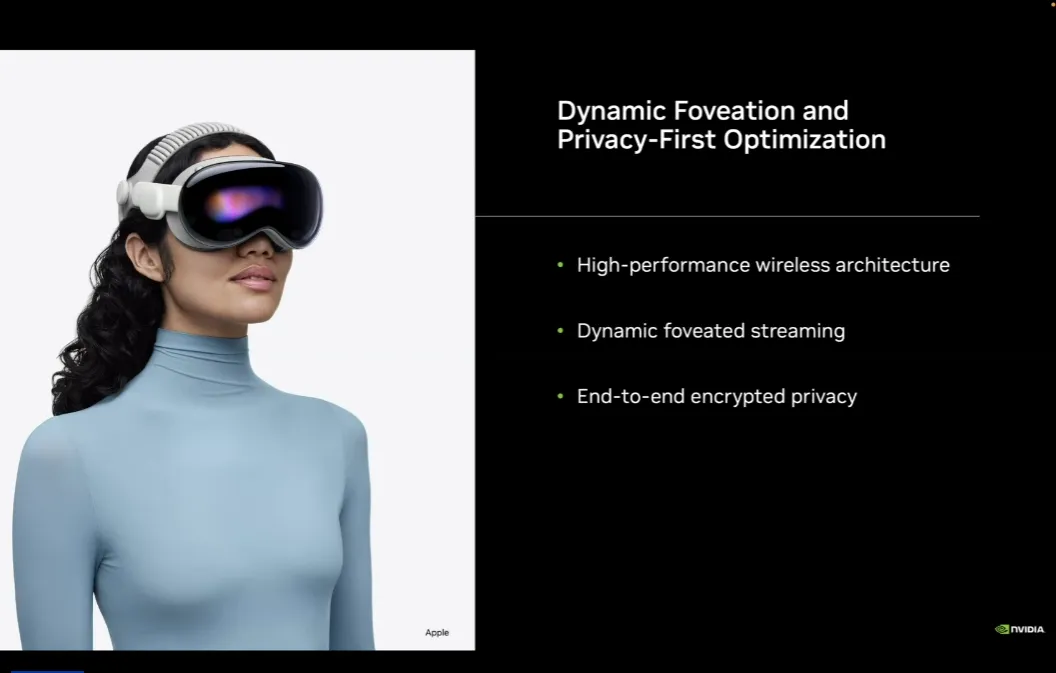
This technology is quite interesting. CloudXR can leverage Vision Pro's eye-tracking to render only your gaze focal area in lossless 4K, while intelligently reducing resolution in peripheral vision.
Like your eyes, the fovea sees clearest, while peripheral vision is relatively blurry. This mechanism maximizes bandwidth reduction while maintaining immersion, keeping latency under 20ms.
End-to-End Encryption
Gaze data is processed locally only, not transmitted or exposed to third parties. This is crucial for industries with strict data compliance requirements like automotive, healthcare, and industrial.
Complete RTX Ecosystem Support
RTX ray tracing, DLSS super-resolution, Omniverse digital twin platform—you can see physically realistic lighting, materials, and precision on Vision Pro.
Build Once, Deploy Everywhere
Developers only need to build once to deploy simultaneously to visionOS, iOS, and iPadOS. Development efficiency improves significantly.
Enterprise Market: From "Show Toy" to "Productivity Tool"
For enterprise users, with CloudXR, lightweight XR devices are no longer presentation tools, but real productivity tools.
Automotive Design: BMW, Kia, Volvo's Review Process Revolution
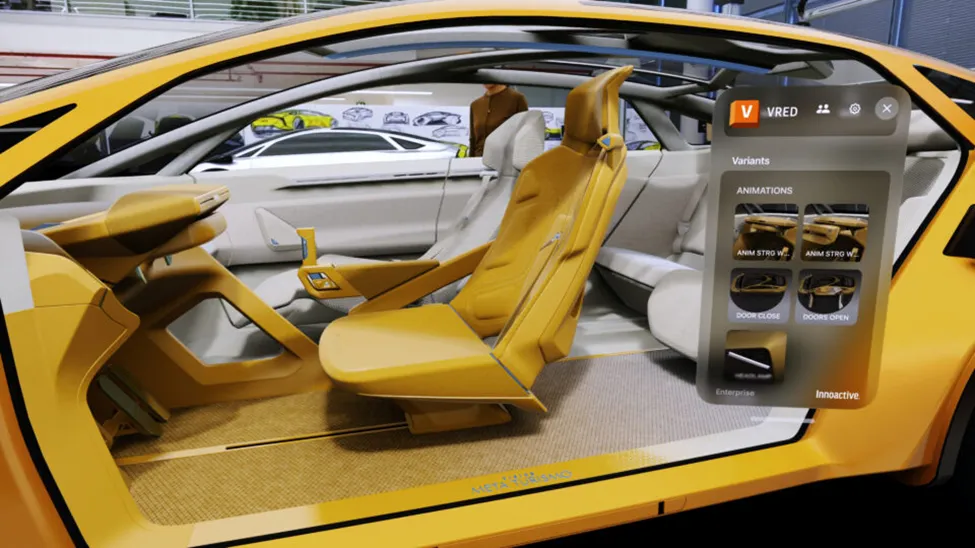
Autodesk and Innoactive's jointly developed Immersive for Autodesk VRED will launch on the App Store this spring.
This app restructures the review process for automotive giants like BMW, Kia, Rivian, and Volvo. With Autodesk VRED and CloudXR, design teams can directly leverage RTX workstations' real-time ray tracing on Apple Vision Pro, viewing ultra-precision models at 1:1 scale in XR environments, observing body surfaces, lighting effects, and materials in real-time.
Karim Habib, Executive Vice President and Head of Kia Global Design Center, said: "We can now evaluate our designs on Apple Vision Pro with greater clarity and speed. We can experience proportions, surfaces, colors, and materials together in shared real environments and collaborate in real-time with global teams."
This is no longer a "future scenario" in PPTs, but a real workflow happening now.
Digital Twins: Foxconn, Switch's Virtual Factories
Foxconn uses Vision Pro with CloudXR for virtual walkthroughs of factory floors, completing layout optimization before actual construction. Data center operator Switch showcases the Omniverse digital twin of its EVO AI factory, optimizing infrastructure in fully immersive spatial environments.
NVIDIA notes that digital twins can improve development process efficiency by up to 30%.
Multi-User Collaboration: Vision Pro + iPad + iPhone
CloudXR supports multi-user shared environments, streaming content to iPad and iPhone in addition to Vision Pro.
Imagine this scenario: some engineers use Vision Pro for fine, wide field of view; designers adjust parameters via tablet; project managers check progress on phone.
This is true spatial computing collaboration.
Consumer Market: High-End XR Content Enters Cloud Era
While CloudXR currently targets enterprise markets, its impact on the consumer market is equally noteworthy.
Flight Simulation, Racing Simulation Land on Vision Pro
Flight simulator X-Plane 12 and racing simulation app iRacing will launch on Vision Pro this spring.
Consumers will experience hardcore simulation content previously requiring high-end PCs on wireless all-in-one Vision Pro for the first time, completely saying goodbye to "wired constraints + castrated image quality."
With CloudXR 6.0, X-Plane 12 achieves wireless streaming at up to 4K resolution, 120 frames per second. This is an experience PC players dream of.
Lower Developer Barriers
Swift native support lets developers build XR apps directly in Xcode, deploying to visionOS, iOS, and iPadOS with one build.
This means more high-fidelity 3D and XR content rapidly landing on Vision Pro, without compromising image quality for mobile computing power. In the future, we may see more hardcore simulations and AAA content flooding into Vision Pro.
The consumer XR content ecosystem may be about to explode.
What Does This Revolution Mean?
The combination of CloudXR and visionOS is far more than a technical collaboration. It's a computing revolution in spatial computing.
For enterprise, digital twins, real-time collaboration, and high-precision simulation become standardized production processes, redefining efficiency in automotive, industrial, and manufacturing industries. XR evolves from "presentation tool" to "productivity infrastructure."
For consumers, high-fidelity simulation entertainment goes wireless and becomes inclusive, activating Vision Pro's consumer potential and letting more people experience truly immersive content.
When spatial interaction meets cloud computing power, XR devices are no longer just display terminals, but gateways to vast computing resources. In this architecture, devices like Vision Pro become entry points for humans into the digital world.
One Final Question
When computing power is no longer a bottleneck, when XR devices can connect to infinite cloud computing power, what will you use it for?
Designing the next world-changing car? Optimizing millions of production lines in virtual factories? Or simulating a better future in digital twin cities?
This question is worth each of us thinking about.
分享文章
3篇相关文章
Apple Cancels Vision Air, This Isn't So Simple
2026-07-10
Apple is quietly abandoning its XR headset strategy, betting everything on AI glasses instead
No More Buffering When Watching NBA on Vision Pro: The Invisible Engine Powering 90% of Immersive Video
2026-06-29
When you watch games on Vision Pro, it's these invisible infrastructures that support visible dreams.
Diamond Substrates for Chip Base? Fudan and Peking University's Black Tech Could Make AI Glasses Say Goodbye to Heating
2026-06-29
Using diamond for chip bases sounds like sci-fi, but it could soon be reality.