
Diamond Substrates for Chip Base? Fudan and Peking University's Black Tech Could Make AI Glasses Say Goodbye to Heating
Diamond Substrates for Chip Base? Fudan and Peking University's Black Tech Could Make AI Glasses Say Goodbye to Heating
What's the biggest pain point of AI glasses? Not display quality, not weight, but—heat.
Have you worn those "smart glasses"? They start getting hot after half an hour, the part touching your skin gets uncomfortably warm, and the battery drains ridiculously fast.
The root cause is chip heat dissipation. Traditional materials are reaching their limits.
Researchers from Fudan University and Peking University have come up with a seemingly luxurious solution—using diamond as the chip base.
Using Diamond for Base, Not for Show
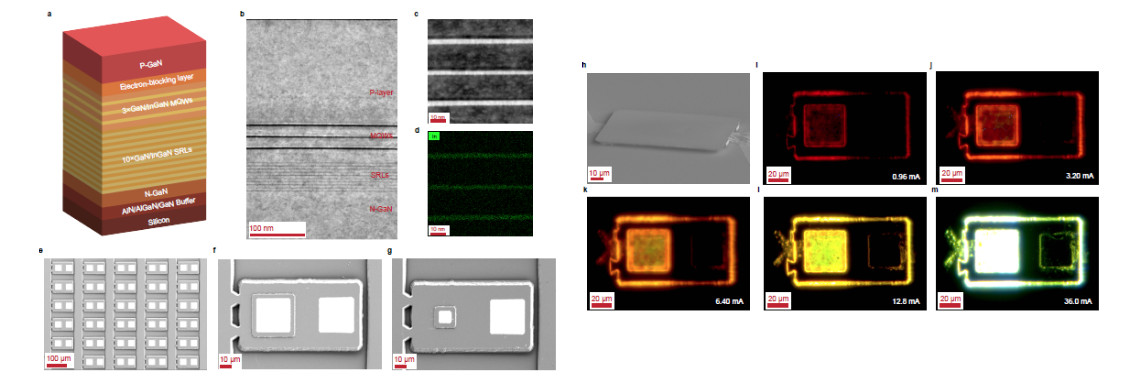
They developed Micro-LED arrays fabricated on diamond substrates.
Diamond's heat dissipation capability is far superior to glass. It can effectively suppress device self-heating while achieving high-speed operation and improving energy efficiency.
This is like giving a high-performance CPU a top-tier heatsink instead of making it tough it out.
How Strong is the Technology?
Look at the data.
The 20-micron yellow Micro-LED achieved 2850.4 MHz electro-optical bandwidth under specific conditions, while the 20-micron red device reached 2593.4 MHz.
This is GHz-level bandwidth, enough to handle massive data.
More critical is the energy efficiency: under on-off keying (OOK) modulation through a 1-meter fiber link, the corresponding energy efficiency was 0.056 pJ/bit and 0.110 pJ/bit, respectively.
Fast transmission, and particularly power-efficient.
Why Invest 15 Million?
This research isn't staying at the paper level. The research team established a commercial company Nexliumen, which just completed a 15 million RMB seed round specifically to advance this technology.
Why would capital invest?
This technology integrates multiple key technologies including long-wavelength InGaN epitaxy, three-quantum-well active region design, diamond heterogeneous integration, transfer printing, and two-photon microlens manufacturing.
This isn't a breakthrough in a single technology, but the打通 of the entire technology chain.
What Problems Can It Solve?
As AI glasses and spatial computing devices demand high-bandwidth, low-power chip interconnects, traditional solutions are approaching their limits.
You want to run complex AI applications on glasses? You want AR glasses to be as smooth as phones? All of this depends on data transfer speed and power performance between chips.
Optical interconnect technology, especially diamond substrate-based Micro-LED, might be one of the answers.
What This Means for the Future
The research team explicitly stated that related technology is expected to be applied to next-generation XR computing platforms.
What does this mean?
Your future AI glasses might not need such large batteries, won't be as hot, and can run more complex applications.
Another roadblock has been removed on the journey from AR glasses as "toys" to "productivity tools."
The Path to Commercialization
Nexliumen isn't the first company to work on Micro-LED, but it's one of the few focused on optical interconnect applications.
15 million in seed funding isn't huge, but it's not small either. What matters is this is a combination of academia and industry—technology from Fudan and Peking University, capital from the market.
This combination is most likely to produce real results.
A Calm View of Tech Breakthroughs
探长 has to remind you, from lab to mass production, there's a hundred thousand miles.
Diamond substrate Micro-LED certainly looks beautiful, but cost, yield, mass production processes—these are all real issues.
However, when a technology direction is validated in the lab, capital is willing to follow, and the team is willing to all in, that itself is a signal.
What's the Next Bottleneck?
Heat dissipation solved, bandwidth improved, power consumption reduced.
What's the next bottleneck? Optical module size? Battery energy density? AI algorithm efficiency?
Every technical breakthrough doesn't make all problems disappear, it just pushes the bottleneck back a step.
But it's these step-by-step advances that turn today's "impossible" into tomorrow's "taken for granted."
Final Thoughts
When you wear AI glasses a few years from now, enjoying lightweight, cool, responsive experiences, you might not realize that this foundational technology breakthrough happened in a lab in 2026.
Using diamond for chip bases sounds like sci-fi, but it could soon be reality.
Technological progress is often this unassuming, yet so important.
分享文章
3篇相关文章
Apple Cancels Vision Air, This Isn't So Simple
2026-07-10
Apple is quietly abandoning its XR headset strategy, betting everything on AI glasses instead
No More Buffering When Watching NBA on Vision Pro: The Invisible Engine Powering 90% of Immersive Video
2026-06-29
When you watch games on Vision Pro, it's these invisible infrastructures that support visible dreams.
VR in 2030 Won't Need Headsets: Leia's Answer
2026-06-25
If you think the future of the metaverse is everyone wearing bulky helmets, you might be wrong.