
VR in 2030 Won't Need Headsets: Leia's Answer
Friends, today the detective wants to talk to you about a signal many people are overlooking.
At the recently concluded AWE USA 2026 conference, a company called Leia made a bold prediction: by 2030, immersive experiences will become "headset-free."
In other words, they believe that in the future, we won't need to wear any headset devices to get VR-like immersive 3D experiences on everyday devices like phones, tablets, and computers.
Is this reliable? Or just more PPT vaporware?
Let's First Understand What Leia is Doing
Leia isn't some new startup. They're veterans in glasses-free 3D and spatial computing technology.
Their core logic is simple: current VR/AR relies too heavily on headsets.
Want to experience immersive content? First, spend hundreds of dollars on a Quest, or thousands on a Vision Pro. Then what? You need to find dedicated time, dedicated space, put on that bulky helmet, and isolate yourself from the real world.
That's too high a barrier.
Leia's idea: can you get immersive 3D experiences on your existing phone, tablet, or computer without changing any usage habits?
Sounds a bit sci-fi, but they've already started doing it.
Three Core Technologies: Making Screens "Stereoscopic"
Leia has built a software-hardware integrated spatial computing platform with three core components:
First, 2D-to-3D AI algorithms.
This thing can convert ordinary 2D videos and photos on your phone into immersive 3D visuals in real-time. Watching YouTube videos? AI converts them directly to 3D. Looking at regular photos? AI can make those 3D too.
Second, single-user viewpoint tracking.
The system tracks your eye position in real-time. When you move your perspective, the on-screen image adjusts accordingly—protruding forward or extending backward. Just like looking at real objects, with realistic perspective.
Third, switchable display technology.
This is most critical. In daily mode, it's just a regular screen—you can work normally, reply to emails. But when you switch to "immersive mode," the screen's microlens structure activates, directing different images to left and right eyes, creating depth through binocular disparity.
One screen, two modes.
Why "Go Headset-Free"?
Friends, the detective thinks the answer lies in "user habits."
Why has VR headset adoption remained low?
Not because the technology isn't good enough, but because it changes user habits.
To use it, you need to:
- Buy equipment (hundreds to thousands of dollars)
- Find time (dedicate specific time for experience)
- Find space (can't move, must be in fixed position)
- Change habits (can't interact with real world)
These four barriers keep 99% of people out.
Leia's approach: add immersive capabilities to devices you're already comfortable with.
You're still using your phone, tablet, computer—just the content you get changes from 2D to 3D.
No habit changes, no extra learning—just what you see becomes three-dimensional.
Real Applications: Not PPT, Already Deployed
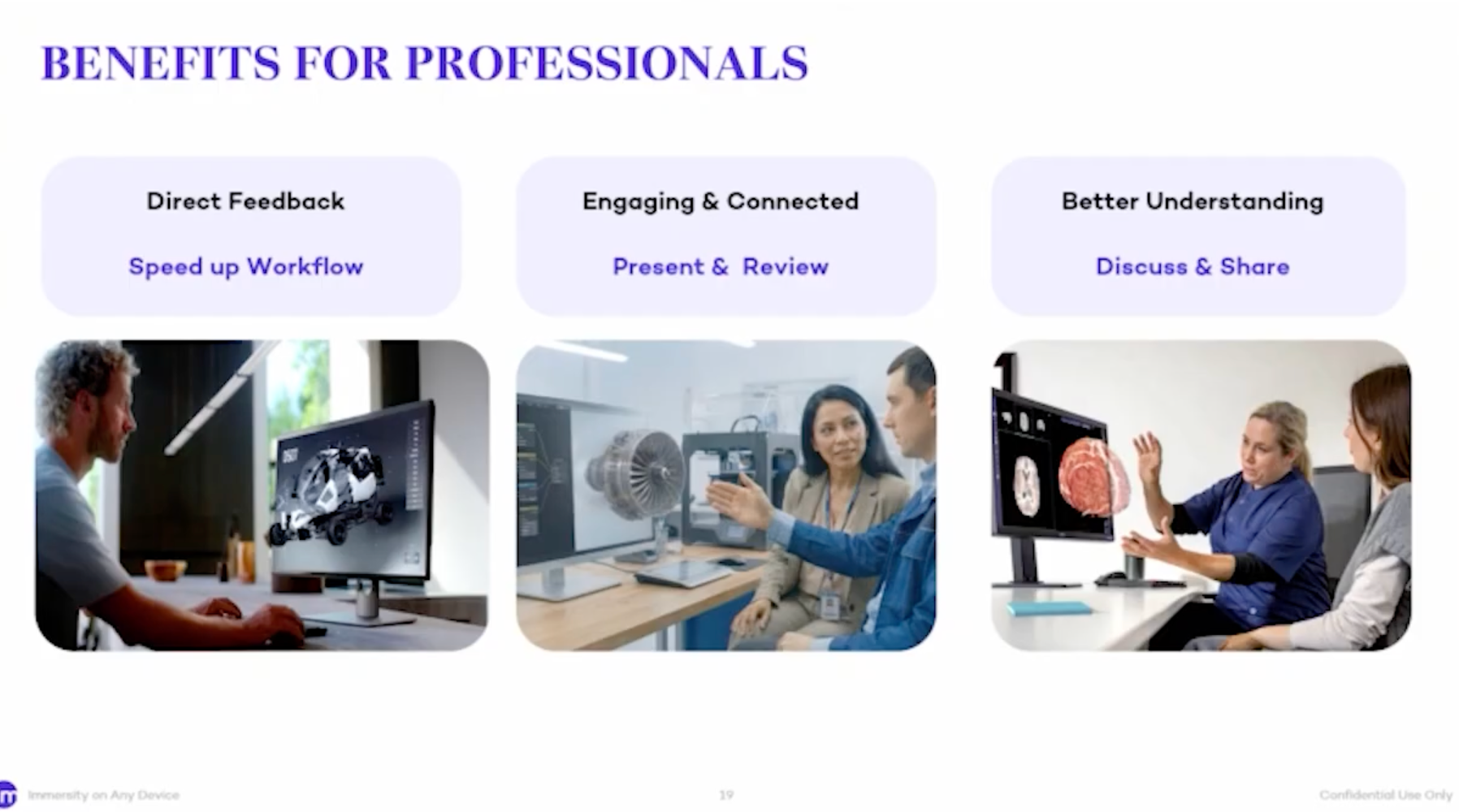
Leia showcased multiple practical application scenarios:
In design and creation, designers can sculpt models and create content in glasses-free 3D environments. No headset needed, just on ordinary tablets or displays.
In medical scenarios, doctors can convert CT scan data into 3D models to help patients better understand their conditions. Imagine a doctor holding a tablet, examining your internal organ structures with you in 3D.
In entertainment, glasses-free viewing of 3D videos, sports events, and gaming content. Watching NBA games on your phone, players seem to jump right out of the screen.
These aren't concept demos—they're applications already running.
Ecosystem Strategy: Open and Compatible, Not Closed
Leia emphasizes an open strategy, compatible with Windows, Android, Unity, Unreal Engine, and OpenXR mainstream platforms.
They've already partnered with hardware vendors like Samsung and Acer, with a clear goal: driving spatial computing capabilities to more consumer electronics products.
This strategy is smart. They don't want to be the next Apple or Meta with closed ecosystems. They want to be the "Android" of spatial computing—providing technology to all hardware vendors, getting it running on more devices.
2030: A Credible Prediction?
Leia's strategy lead Jochem Taminiau said in the speech: "We believe the shift from interactive experiences to more immersive experiences will become mainstream by 2030."
Friends, the detective thinks this timeline is credible.
Why?
In terms of technological maturity, AI algorithms, 3D display technology, and spatial interaction methods are all rapidly iterating. In another 4 years, these will become very mature.
In hardware adoption, screens supporting 3D displays will become more numerous, costs will drop lower.
In content ecosystems, 2D-to-3D AI technology will solve content supply issues—you don't need to shoot 3D content specifically, AI can convert it for you.
In user demand, the demand for immersive experiences is real—only the barriers were too high before.
When barriers are eliminated, demand will be released.
In Closing
Leia is betting on one thing: the endgame of spatial computing isn't closed headset hardware, but ubiquitous immersive screens.
They want digital content to seamlessly integrate into the physical world in the most natural, imperceptible form.
The detective thinks this direction is right.
Because the ultimate form of technology should be "disappearing"—not making you wear bulky equipment to adapt to technology, but having technology quietly blend into your life, giving you better experiences when you don't even notice.
In 2030, when we look back at today, we might think: so primitive, we were still wearing headsets for VR back then.
Friends, the future might really not need headsets.
Just a screen, and a pair of eyes that can see in three dimensions.
分享文章
3篇相关文章
Apple Cancels Vision Air, This Isn't So Simple
2026-07-10
Apple is quietly abandoning its XR headset strategy, betting everything on AI glasses instead
No More Buffering When Watching NBA on Vision Pro: The Invisible Engine Powering 90% of Immersive Video
2026-06-29
When you watch games on Vision Pro, it's these invisible infrastructures that support visible dreams.
Diamond Substrates for Chip Base? Fudan and Peking University's Black Tech Could Make AI Glasses Say Goodbye to Heating
2026-06-29
Using diamond for chip bases sounds like sci-fi, but it could soon be reality.