
You've Probably Never Heard of DPVR, But You've Likely Worn Its Headsets
Meta has admitted in its earnings report that Quest sales are declining, and Sony's XYN is still waiting for creators — consumer VR is having a rough time. Yet one Chinese company has quietly become the world's largest OEM VR brand by shipments.
It's called DPVR, aka Shanghai Lexiang Technology, founded in 2015.
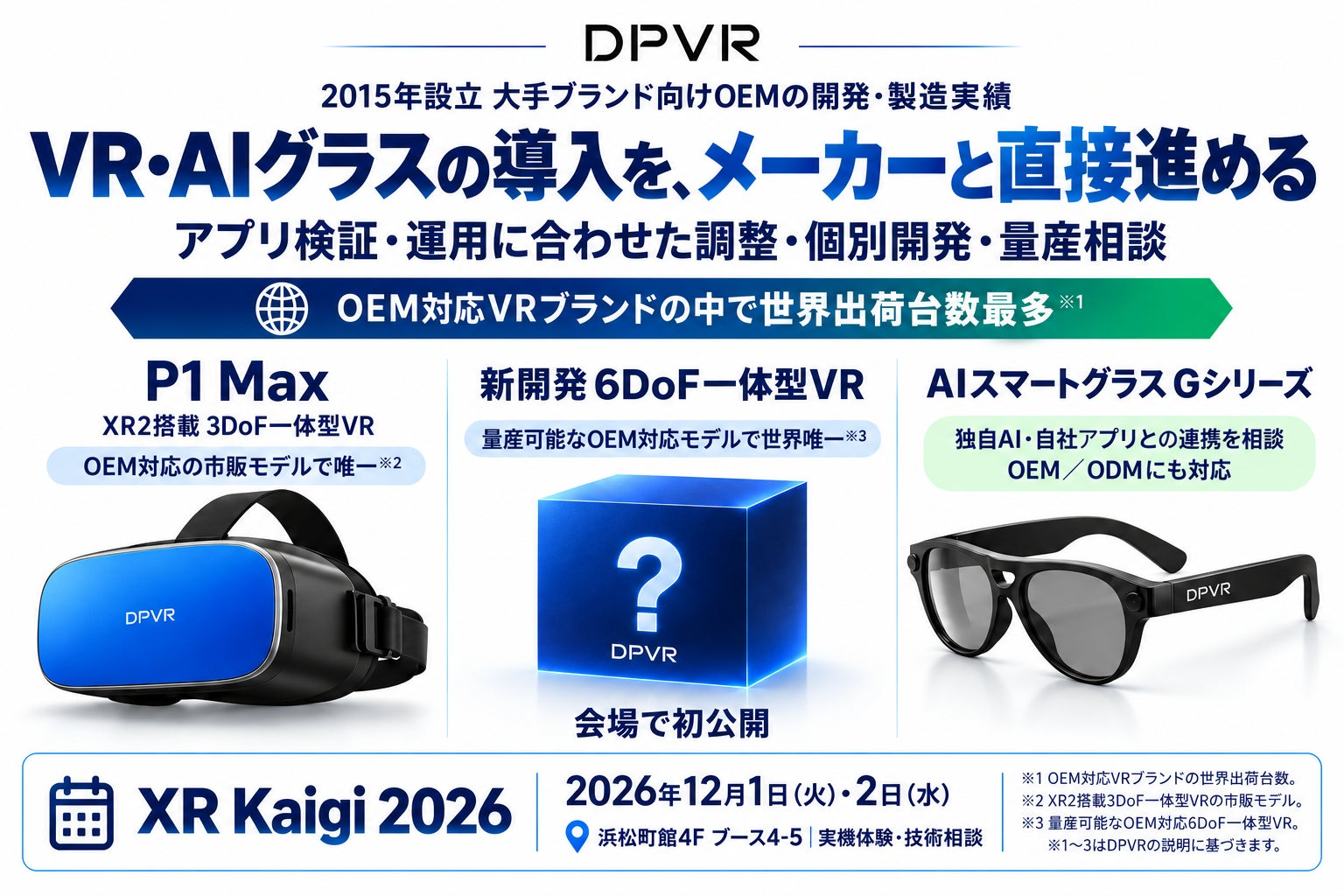
On October 27, DPVR announced it will globally debut two new products at XR Kaigi 2026 in Tokyo on December 1-2: a brand-new 6DoF standalone VR headset, and "DPVR AURA," a smart glasses with waveguide display.
What's Interesting About These Launches
First, the 6DoF standalone headset. The official claim is bold: the world's only 6DoF standalone VR that supports both OEM development and mass production.
Translation: 6DoF means six degrees of freedom — the headset knows not just when you turn your head, but when you step forward, sideways, crouch, or stand up. It's the foundation of immersion, and making it work in a standalone unit that can also be mass-produced for brand partners is, per the company, an industry first.
Then there's the "DPVR AURA" glasses. Waveguide optics, with the image displayed directly on the lens. The venue will stock prescription lenses from +6.00D to -8.00D, so nearsighted and farsighted visitors can try the real wearing experience on-site. That detail matters: if waveguide glasses are ever going mainstream, prescription compatibility is the first hurdle.
Why This Company Deserves Attention
DPVR's main battlefield isn't the retail shelf — it's behind the scenes.
It builds headsets for major global brands and claims the world's largest shipments among OEM VR brands. What it's selling in Japan isn't consumer hardware, it's a full white-label business: orders from 100 units, app verification, custom boot screens, firmware locking, and SDK integration with clients' own AI and business systems — all negotiable.
The target scenarios are clear: education and training, industrial skills training, video broadcasting, and amusement park operations. All places where B2B clients pay promptly and renew reliably.
Also on display is the P1 Max: Snapdragon XR2 with 8K playback, running 24 hours straight on direct power — aimed at showrooms and retail stores where the device simply can't stop.
The Detective's Take
Consumer VR cooling down is a fact, but the XR business isn't dead — it just changed how it makes money. Consumer side tells stories; enterprise side collects cash. DPVR is a textbook example of the latter.
While the Metas of the world debate when the consumer market will take off, Chinese OEMs have already deployed hundreds of thousands of devices in schools, factories, and theme parks. The foundation of the metaverse may not be laid by consumers, but stacked up by enterprise clients, order by order.
Keep an eye on the AURA waveguide glasses, though. If the waveguide-plus-prescription combination turns out to be genuinely comfortable, the "all-day wearable AR glasses" move one step closer.
One question: as VR industry money flows increasingly from consumer wallets into enterprise accounts, is the consumer metaverse we've been waiting for just not here yet — or was it never needed at all?
分享文章
3篇相关文章
Free Upgrade on Day 3: A $650 VR Headset Doubles Its Panels and Battery Mid-Campaign
2026-10-26
Japan's Walker Industries upgraded backers from 1600x1600 to 2160x2160 panels and a 85Wh cell just three days into its Kickstarter — and plans to open source the whole headset. Inspiring story, real risks too.
37 Minutes, One Dead Cat, and an International VR Film Grand Prize
2026-10-26
While everyone else uses VR to make shooting games, Japanese director Jun Wada made a film about loss and healing — and swept awards from Venice to Kaohsiung.
VR Tactical Shooter Geronimo: When Virtual Death Teaches Real-World Communication and Collaboration
2026-07-27
Steam just launched a VR tactical shooter called Geronimo—aimed at squad tactical combat, rough around the edges but gets the core right.