
Yuga Labs Bets Big on Unreal Engine: Ragnarok or Genesis for the Metaverse?
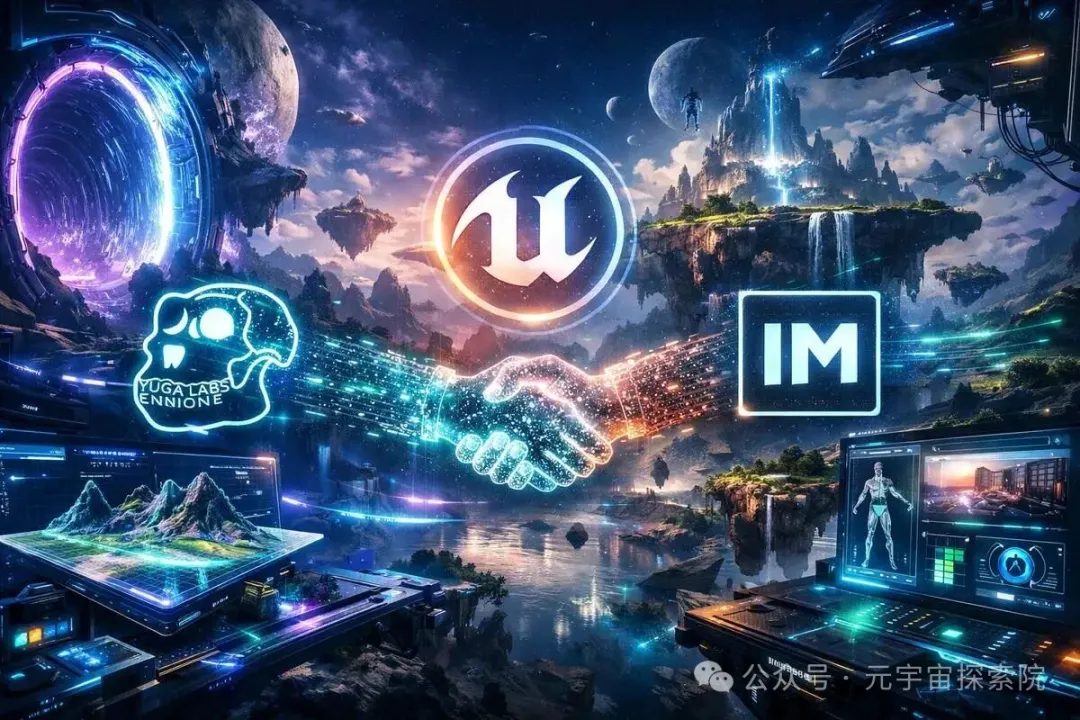
The metaverse winter hasn't completely passed, but Yuga Labs has already decided to pick up the shovel early and build the foundation for the future.
Recently, Web3 giant Yuga Labs announced the acquisition of Improbable's Unreal Engine-based development platform. This move has created quite a stir in the industry. Many are asking: when everyone is talking about AI and large models, why is Yuga, which got its start with "Bored Apes," still investing heavily in what seems like an outdated metaverse?
In truth, this isn't a simple acquisition. It's more like a "power consolidation" move.
Farewell to "Assembly Line," Becoming "Creator"
For a long time, Yuga Labs' core project Otherside has been more like a product of "technology outsourcing." The underlying technology was in others' hands—development progress, user experience, even how many users could be online simultaneously—all depended on partners' whims. This feeling of "being at others' mercy" clearly doesn't match Yuga Labs' ambitions.
This acquisition essentially gives Otherside a "self-developed heart."
By taking over Improbable's high-concurrency technology, Yuga solves the most awkward pain point in the metaverse: lag. You may have experienced the nightmare of thousands of people cramming into the same digital space, with the screen instantly turning into a slideshow. Unreal Engine's integration aims to make tens of thousands of simultaneous users and smooth interactions possible.
Talent is the Hardest Currency
Code is dead, but people are alive. The most valuable part of this transaction is actually the group of top engineers transitioning from Improbable.
In the Web3 space, finding people who understand blockchain isn't hard, and finding people who understand AAA game architecture isn't hard either, but finding cross-disciplinary talent who can handle both is extremely rare. With this elite team, Yuga can finally achieve true internal iteration. No more communication delays, no more requirement gaps—every creative idea can be directly implemented down to the pixel level.
The Final Piece of the Empire Blueprint
Looking back at Yuga's recent moves, you'll find they're playing a very large game.
ApeChain handles money and rights issues—payment and ownership verification; Unreal Engine platform handles face and experience—visuals and interaction; while $APE token is the blood flowing through it all. This vertical integration model puts unprecedented pressure on established competitors like Sandbox or Decentraland.
Simply put, Yuga doesn't want to just make a game—it wants to build an operating system where everyone can "open a shop with one click, build a house with one click."
Optimism and Cold Reflection: Will 2026 Be the Final Battle?
Community voices are interesting. Supporters see this as a shot of adrenaline, believing Otherside will finally escape the "PPT stage." But there are plenty of skeptics: no matter how advanced the technology, if no one plays it, isn't it just a magnificent island?
Indeed, the metaverse narrative has evolved from "selling land" to "competing on infrastructure." People no longer believe in pie-in-the-sky visions—they want to see real experiences.
If we look ahead to 2026, things could get very interesting.
At that point, if your NFT is no longer just a static image in your wallet, but a "ticket" that seamlessly enters AAA-quality scenes, this appeal would be a dimensional downgrade for traditional players. Yuga Labs' move is stockpiling ammunition in advance for that possible "grand parade" that may come.
Conclusion: No More Believing in PPTs
The second half of the metaverse competition is about hard strength, not storytelling. Yuga Labs' "all-in" move sends an extremely clear signal: Web3 giants have realized that marketing and IP alone can't sustain a world. Only with a strong enough technical foundation can consensus take root.
The charm of technology lies in the fact that when everyone is most pessimistic, it's quietly brewing the next storm through underlying reconstruction. Yuga Labs' bold bet may be at the center of that storm. As for how far away it is? 2026 will provide the answer.
分享文章
3篇相关文章
40 Grams - iFlytek's AR Glasses Finally Got the Weight Right
2026-03-03
Weight is everything. What does 40 grams mean? Regular optical glasses weigh about the same.
PICO's Counterstrike: Custom Chip + New System, Taking on Vision Pro Head-On
2026-03-03
After a year of silence in the VR industry, PICO has finally made its move. On March 2nd, they dropped three cards: a custom coprocessor chip, Project Swan flagship headset, and PICO OS 6 spatial operating system.
The AR Glasses Capital Frenzy: $200 Million in 6 Months
2026-03-03
Just 6 months, another $100 million raised. VITURE has created a storm in the capital markets.