
2025, Is the Metaverse 'Dead'? Nvidia and Roblox Smile Silently!
Rebirth After Tearing Off the "Empty Fame": 2025 Metaverse Survival Records, Who's Cashing Out, Who's Quietly Profiting?
If 2021's metaverse was like a wild late-night party that everyone joined, then in 2025, we're in the morning after the hangover.
The wind is biting outside the window, and the house is a mess of cups and plates.
Three years ago, Zuckerberg's announcement gave birth to Meta, virtual land sold for astronomical prices, as if humanity would collectively "plug into dreams" tomorrow. But three years later, as the fervent narrative tide recedes, those swimming naked have long disappeared beyond the horizon, leaving only road workers and thoughtful hunters.
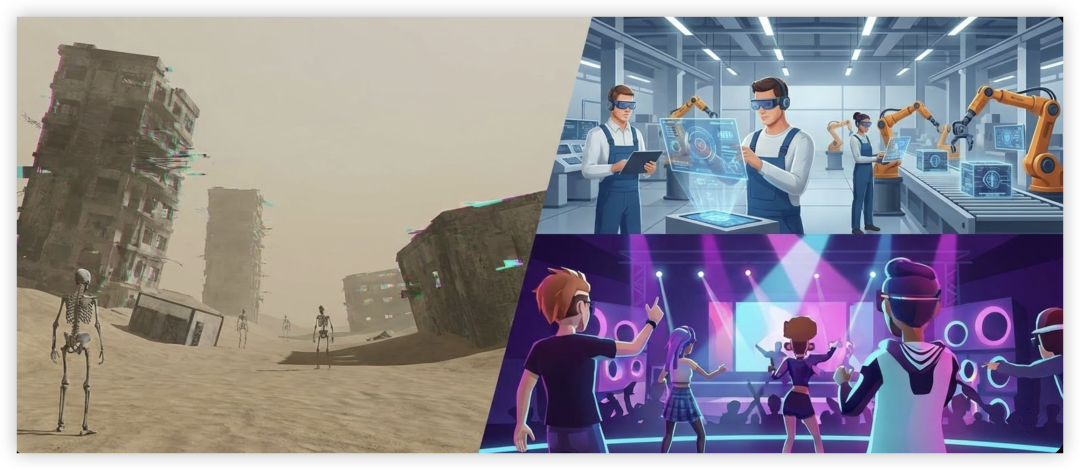
2025's metaverse shows extreme division. On one hand, crypto real estate like Decentraland has become "digital ghost towns," eerily quiet; on the other, Roblox's daily active users have exceeded 150 million, and Nvidia's Omniverse has more industrial orders than it can handle.
This once-maligned term is experiencing a hidden and profound "dimensional downgrade."
Disappearing Labels, Growing Flesh and Bone
The metaverse industry now presents an interesting paradox.
The more successful platforms are, the more eager they are to tear off the "metaverse" label. Leader Roblox now prefers to talk about "creator ecosystems"; while the truly profitable areas, like digital twins, present themselves like seasoned productivity tools.
The metaverse isn't dead—it's just learned to "go invisible." It's no longer a standalone destination, but has been broken down, kneaded, and quietly integrated into every gap of social, gaming, hardware, and factories. It's become an AI-empowered, upgraded human-computer interaction experience.
Top Players' "Defection": Not Speaking, But Doing
Immersive gaming remains the hardest foundation of this landscape. The awkward thing is, Roblox is already deliberately downplaying the word "metaverse."
Data doesn't lie. In Q3 2025, Roblox's daily active users surged to 150 million. Its secret isn't some grand concept, but creating an extremely sticky "digital third space." Young people watch Sabrina Carpenter's virtual concerts here, buy digital fashion brands here—they're not doing it to "enter the metaverse," they're just socializing.
Epic Games follows the same logic. Fortnite now is more like a container that holds everything, with nearly half of playtime spent on third-party content. Top players have learned a lesson: rather than selling ethereal visions, it's better to honestly build foundations.
Industrial Sector: The "Money Printer" Making Quiet Profits
While consumer metaverse still worries about "retention rates," industrial metaverse has already started calculating returns.
In 2025, this market's scale approaches $50 billion. Nvidia's Omniverse is no longer a flashy demo—it's become standard equipment in BMW, TSMC, and Foxconn workshops. BMW uses digital twins to simulate production lines, directly shortening new car launch cycles by 30%; Boeing uses AR glasses to assemble parts, reducing error rates by 40%.
This is a brutal truth: the metaverse didn't first change how we entertain ourselves, but how production is organized. Here, it's not a bubble on PowerPoint slides, but a real cost-reduction and efficiency tool.
Hardware Upheaval: Farewell to "Diving Helmets"
This year's hardware market is unevenly hot and cold.
Apple's Vision Pro remains a luxury at the pinnacle—though outrageously expensive, it sets the rules for "spatial computing." Meta holds the mass market with Quest 3.
But the real dark horse is smart glasses. Meta's Ray-Ban collaboration has sold like crazy. It doesn't aim for complete immersion, just integrates an AI assistant and lightweight display, making you want to wear it all day. This hints at a trend: the metaverse's entry point might not be a clunky diving helmet, but a pair of ordinary glasses that can navigate, take photos, and translate in real time.
Reflections in the Ruins: Trust is More Expensive Than Land
In contrast, the once-glamorous "crypto metaverse" still struggles in the mud.
Virtual land trading volume has shrunk by 90%. Those plots bought at astronomical prices now only have hundreds of users wandering around. Excessive financialization and speculative narratives have completely exhausted public trust.
Although developers are working hard to lower barriers with AI generation tools, lost confidence is hard to recover. Digital assets without content support ultimately become an expensive digital illusion.
Conclusion
In 2025, the metaverse is no longer a "buzzword" waiting to explode, but a "gradual transformation" happening right now.
It's accelerating growth with AI's empowerment. When you can generate a 3D scene directly with voice, when your virtual avatar has real emotional feedback, when we're used to AR glasses replacing phones, we're already living in the embryo of the metaverse.
The keyword for the second half of this evolution is "integration."
Those who still insist "the metaverse is a scam" might soon find themselves wearing lightweight smart glasses in digitized factories, enjoying AI-generated immersive services.
分享文章
3篇相关文章
The Metaverse Reaches Physical Industries! Nvidia Partners With BMW And Siemens To Build A Digital-Twin Empire!
2025-11-13
The metaverse has moved beyond science fiction into the next business frontier. This deep dive shows how Lowe's, Kroger, BMW, Siemens, and ILM use NVIDIA Omniverse and related technologies to construct virtual worlds that fuel innovation and growth.
Hitachi Launches Nuclear Metaverse: Bringing Power Plants into the Virtual World
2025-07-14
Hitachi unveils a groundbreaking nuclear power plant metaverse platform, ushering nuclear operations into a new digital era to boost safety, efficiency, and address talent challenges.
Industrial Metaverse Reaches a Turning Point: From Hype to Real-World Value!
2025-07-09
Once the subject of wild speculation, the metaverse is quietly reviving in the industrial sector, showing surprising practical value as attention shifts from consumer entertainment to real-world applications.