
13 Tons of VR Headsets Cross the Ocean: Valve's Hardware Gamble
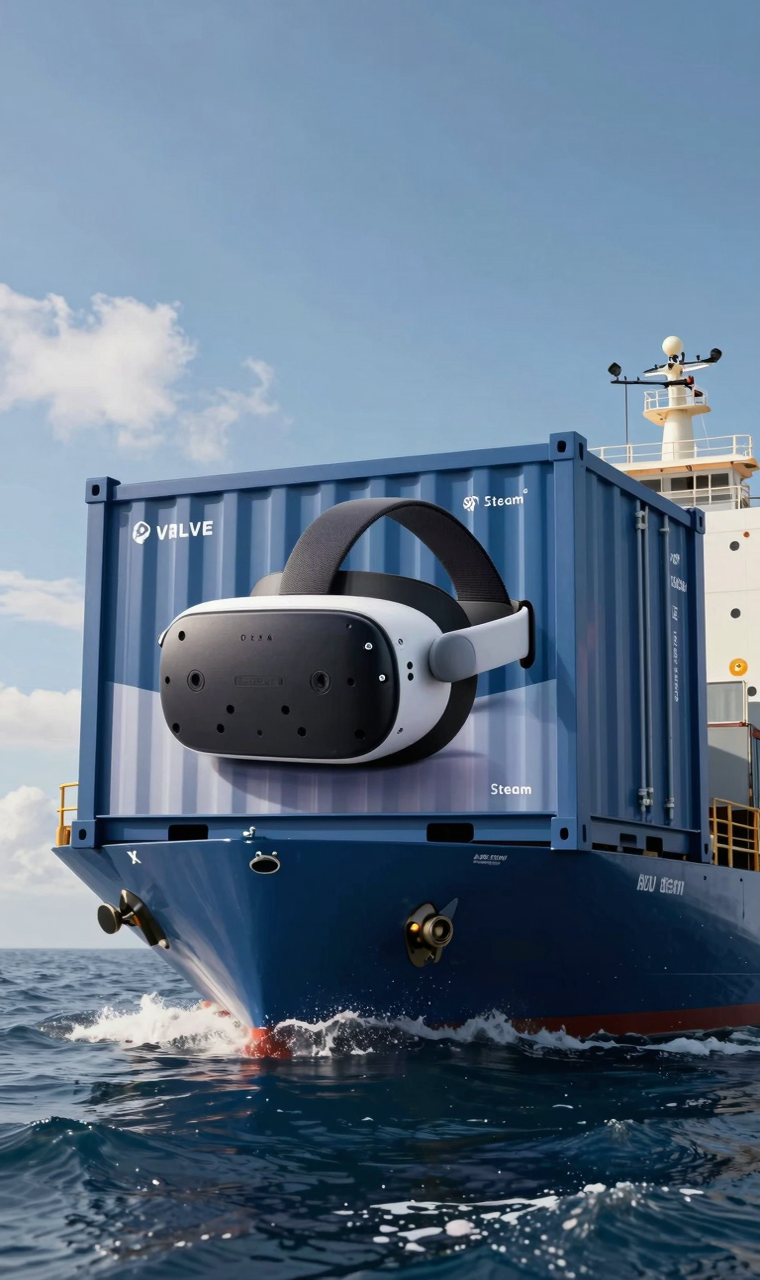
Friends, today the Detective wants to talk about an interesting detail—a container ship from Shanghai recently arrived in Los Angeles.
On board was Valve's VR headset.
13 tons.
This isn't small-scale trial production, but genuine bulk cargo. For a company that's been making software for 20 years, this means Valve is finally taking that step—from virtual to reality, from code to hardware.
What Does 13 Tons Mean?
Let's start with how this 13-ton figure was calculated.
Tipster Brad Lynch discovered that a German container ship named Posen, which departed from Shanghai, arrived in Los Angeles carrying what is almost certainly the first production batch of Valve's new VR headset, the Steam Frame.
Import customs records show that Valve's logistics partner, Ceva, cleared nearly 32 tons of "virtual reality equipment" on Valve's behalf. After deducting the container weight of about 3.7 tons for five 40-foot containers, the net weight of the equipment is approximately 13 tons.
This calculation method was confirmed by foreign media The Verge—they used the same approach last month when calculating Valve's import of 50 tons of game consoles.
So the question arises: 13 tons of VR headsets, how many units is that?
Each Steam Frame headset comes with a pair of controllers weighing 654 grams each. Rough estimate: this shipment contains under 20,000 units.
This number isn't large, but for a company that has never made VR hardware before, it's already a bold start.
Why Valve?
At this point, you might ask: Why Valve?
After all, Valve isn't a hardware company. It's the operator of Steam, the creator of Half-Life, a software giant in the gaming industry.
But friends, the Detective must remind you—Valve has been waiting for this opportunity.
Think back to 2016, when Valve almost made VR. When HTC Vive launched back then, it was Valve's technology behind it. But Valve ultimately chose cooperation rather than going it alone.
Why? Because the VR market wasn't mature then—technology wasn't ready, the ecosystem wasn't ready, users weren't ready.
But now it's different.
Meta's Quest series has educated the market, Apple's Vision Pro has defined the high-end experience, and Steam already has hundreds of millions of users ready to embrace VR gaming.
Valve entering now isn't following a trend—it's waiting for the wind to blow.
What Can Steam Frame Change?
So, what can Steam Frame actually bring?
Based on current information, we know it's not positioned as high-end, but rather takes a mass-market route. Valve explicitly stated that due to the memory price crisis, they had to readjust pricing.
What does this mean? It means Valve doesn't want to compete with Vision Pro on specs, but rather compete with Quest on value.
For Steam users, this is good news.
You don't need to buy Meta's hardware, don't need to use Meta's account, don't need to endure Meta's ecosystem lock-in. You just need a VR headset that seamlessly integrates with the Steam platform—play Half-Life: Alyx right out of the box, experience thousands of VR games on Steam.
For Valve, this is also a critical step.
Steam has been too successful, successful enough to need new growth curves. VR gaming is this new curve. Valve needs its own hardware to ensure this curve can unfold smoothly.
Why Only 20,000 Units?
At this point, you might ask: Why only 20,000 units in the first batch? Isn't this too few?
Friends, the Detective has to say—this is precisely Valve's prudence.
Valve has never been an aggressive company. It won't throw money to subsidize the market like Meta, nor will it spend heavily on marketing like Apple. It's the operator of Steam, and it understands the logic of long-term operations.
20,000 units—enough to test market reaction, enough to collect user feedback, enough to validate the supply chain, and enough to prepare for the next production run.
This isn't called conservative—it's called rational.
Valve knows the VR market is still in its early stages, users are still being educated, and the ecosystem is still being perfected. Dumping a few million units into this now serves no purpose other than inventory buildup.
Can We See It This Summer?
Valve confirmed days ago that Steam Frame will launch this summer.
But friends, the Detective must remind you—this summer might be more complicated than we imagine.
The memory price crisis is just the surface. Behind it is the tension across the entire supply chain. Displays, chips, sensors—all components needed for VR headsets are getting more expensive.
Valve readjusting pricing means they don't want to sell hardware at a loss, but don't want to sell at a premium either. They're looking for a balance point—attracting users while preserving profit margins, and leaving room for future price cuts.
This balance point isn't easy to find.
Hardware Isn't the End
Finally, the Detective wants to talk about Valve's ambition.
Valve making hardware isn't about becoming a hardware company. It's not about selling 20,000 headsets for profit, nor about grabbing market share.
Valve making hardware is to protect Steam's future.
Steam is the largest PC gaming distribution platform, but as gaming forms evolve, Steam also needs to evolve. VR is the next form of gaming, and Valve needs to ensure Steam remains at the core of this form.
Steam Frame isn't the endpoint, but the starting point.
It might become Steam's living room entry point, the infrastructure for Valve's metaverse vision, the bridge connecting PC, VR, and even future AR devices.
From this perspective, 13 tons of VR headsets crossing the ocean carries not 20,000 devices, but Valve's bet on the form of gaming for the next decade.
VR's Next Decade
If Steam Frame really succeeds, what happens next?
Will Steam fully embrace VR? Will Valve release more VR-exclusive games? Or will Steam become the standard distribution platform for VR gaming?
These questions have no answers now, but they're worth thinking about.
Friends, do you think Valve's VR hardware can change the industry landscape? Will Steam Frame become standard equipment for VR gaming, or will it be like countless VR devices—flash in the pan, then forgotten?
These 13 tons of cargo might be a small node in the VR industry, or it might be a major turning point in Valve's history.
History will tell us the answer.
分享文章
3篇相关文章
VR Tactical Shooter Geronimo: When Virtual Death Teaches Real-World Communication and Collaboration
2026-07-27
Steam just launched a VR tactical shooter called Geronimo—aimed at squad tactical combat, rough around the edges but gets the core right.
Nurses Must 'Face Violence' Before Internship: How This University Uses VR to Teach Self-Protection
2026-06-16
Australia First: UTS Makes VR Violence Prevention Training Mandatory for Nursing Students
Pico's Next Headset Leaked: Did Their Designer Copy Apple and Samsung's Homework?
2026-06-12
Pico's next flagship headset Project Swan leaked unexpectedly, and why does this design look so familiar? Independent battery, woven head strap, 270g weight... I feel like I've seen this before.