
A $24 Billion Invisible Giant Is Quietly Changing the Game for AI Glasses
A $24 Billion Invisible Giant Is Quietly Changing the Game for AI Glasses
Friends, today the Detective wants to chat with you about something interesting.
Do you know what it means when a "invisible champion" with over 24 billion yuan in annual revenue and deep roots in the IoT field for over a decade suddenly announces it's entering the AI glasses arena?
This isn't a crossover - this is a dimensional attack.
A Not-So-Obvious Signal
On June 5th, VR陀螺 obtained exclusive news from insiders: Quectel - this global IoT communications leader is aggressively expanding into the AI glasses business and plans to launch multiple ODM/OEM solutions this July.
Note, not testing the waters, but "multiple models."
Many friends might not be familiar with the name Quectel. Let me give you a quick introduction:
Founded in 2010, this company is a top player in global IoT solutions. Their 2025 financial report shows revenue of 24.326 billion yuan and net profit of 837 million yuan, with both growing over 30% year-over-year.
For over a decade, they've been working on communication modules, AI computing modules, GNSS positioning modules - stuff that sounds pretty boring. Their customers are everywhere: smart transportation, smart energy, smart cities, intelligent robots, and more.
In other words, this company has been providing the "neural network" for the Internet of Things.
But now, they want to install this nervous system into your glasses.
Secrets Hidden in the Financial Report
I went through Quectel's 2025 annual report and found an interesting detail:
"In 2025, Quectel's AI glasses solutions helped a leading AR customer achieve ten-thousand-unit shipments."
Friends, don't underestimate this "ten-thousand-unit level." In a market that's just getting started like AI glasses, being able to run ten-thousand-unit projects shows the product has passed the "concept validation" phase and entered real commercialization.
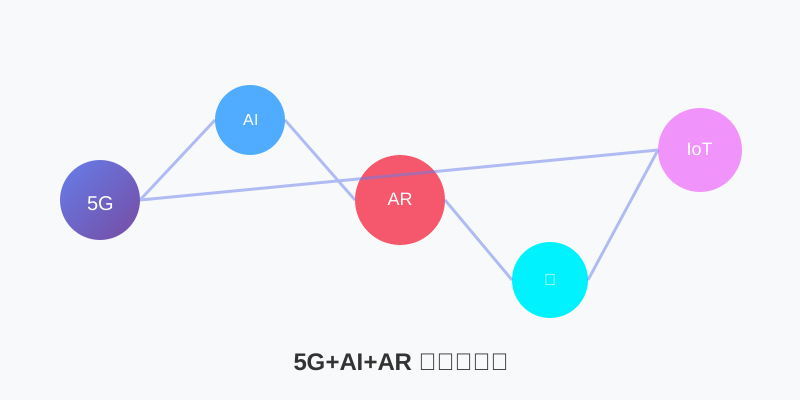
Even more crucially, Quectel explicitly stated in their annual report: Entering 2026, the company will launch a "5G+AI+AR integrated solution," adopting a local processing and cloud collaboration architecture to further improve computing power and response speed.
This aligns perfectly with the insider news about "launching multiple AI glasses solutions in July."
In other words, Quectel didn't do this on a whim or as a temporary move. They've gone from customer projects and solution validation to a clearer stage of productization and platformization.
Why 5G?
Friends, have you ever wondered why current AI glasses can't seem to break free from phones?
Whether it's device activation, network connection, or cloud-based complex AI tasks, many products need to pair with phones before use. From a form factor perspective, they're more like "wearable accessories" for phones.
But once AI glasses have independent communication capabilities, the situation changes completely.
You can break free from phone restrictions, make calls anytime, achieve lower latency and more stable AI conversations. This is a key factor in whether it can become a true next-generation mobile computing entry point.
And this is the most noteworthy aspect of Quectel's "5G+AI+AR solution."
However, there's a technical challenge here: the glasses form factor is highly sensitive to weight, power consumption, heat dissipation, and internal space - it simply can't accommodate phone-level 5G solutions.
But AI glasses need to continuously process multimodal data like voice, images, and video, with extremely high requirements for real-time networking, uplink bandwidth, and low latency.
Quectel's answer is: 5G RedCap.
RedCap has low power consumption, miniaturization, and efficient connection capabilities, and is becoming an important technical path for terminals like smart glasses. Let me translate for you: this is "lightweight 5G" specifically designed for IoT devices.
Quectel's annual report cites Ericsson's "Mobility Report," which points out: it's expected that within the next 2-3 years, smart glasses with independent 5G connection capabilities will gradually become popular; by 2031, devices like AI, AR/VR glasses, and intelligent assisted driving vehicles will become the main drivers of IoT uplink traffic.
In other words, the era when glasses break free from phones and become independent computing terminals is arriving faster than we imagined.
Chain Reactions After Big Tech Enter
Of course, the rapid amplification of market demand is the most direct reason for Quectel to increase its investment in AI glasses.
Currently, tech giants like Apple, Samsung, Meta, Alibaba, Huawei, Snap, and Xiaomi are all working on AI glasses.
Meta may bring 4 AI glasses models within the remainder of 2026, including at least one AI+AR glasses with display.
Apple will also launch its first AI glasses as early as 2027. According to TF International Securities analyst Ming-Chi Kuo's supply chain investigation, Apple's "display-free AI glasses" similar to Ray-Ban Meta are expected to go into mass production in 2027, while "AR/XR smart glasses with display" have been delayed to 2029.
When all big players enter the field, the supply chain war truly begins.
According to陀螺研究院's "2025 Global VR/AR Industry Development Report," global AI glasses shipments were approximately 8.8 million units in 2025, a year-over-year increase of 376%, and are expected to exceed 16 million units in 2026.
In this window period, competition is no longer just between terminal brands. For AI glasses to truly achieve volume growth, it requires the joint maturity of chip platforms, communication modules, cameras, audio, optical displays, batteries, structural design, and complete machine solution capabilities.
Quectel is aiming precisely at the new demands for connection capabilities, complete machine solutions, and large-scale delivery capabilities in this process.
Supply Chain Awakening
Friends, let me share an observation with you:
When an emerging industry begins to truly achieve volume growth, the first to benefit are often not those making brands, but those providing core technologies and solutions.
Because they hold the keys to large-scale delivery.
Quectel's preparation to launch multiple AI glasses ODM/OEM solutions is not just following a consumer electronics hotspot. More precisely, it's targeting the new demands for connection capabilities, complete machine solutions, and large-scale delivery capabilities in the process of AI glasses moving from small-scale trials to mass shipments.
The AI glasses market is heating up, and this time, stepping into the spotlight are not just terminal manufacturers, but also those upstream solution providers who have long been hidden behind the hardware.
When a $24 billion IoT leader starts taking AI glasses seriously, the rules of this game may need to be rewritten.
Friends, do you think AI glasses will replace phones and become the next mobile computing entry point? Or will they become phone accessories like smartwatches?
This question is worth our continued observation in the coming years.
分享文章
3篇相关文章
Meta's AI Glasses Dilemma: When Your Glasses Know You Better Than Yourself, Should the Privacy Light Be On?
2026-07-30
When your glasses know you better than you know yourself, do you have a more convenient life, or deprived privacy?
Chinese AI Glasses Company Becomes Unicorn: What Does This Signal?
2026-07-09
Chinese smart glasses company Even Realities secured $150 million in funding, reaching a $1 billion valuation to become a unicorn. Led by Meituan and Tencent.
The 'Steam Engine Moment' for 3D Content Production: VAST Raised 1 Billion RMB
2026-07-02
When giants like Geely, Giant Network, and 4399 all bet on a 3D AI model startup, I think this signals something meaningful.