
NVIDIA Pours $3 Billion into Meta — This Time It's Not About GPUs, It's About AI Employees
On October 26, a depth charge hit the tech world: NVIDIA announced a $3 billion investment in Meta, along with an expanded partnership around Meta's AI model family, "Muse."
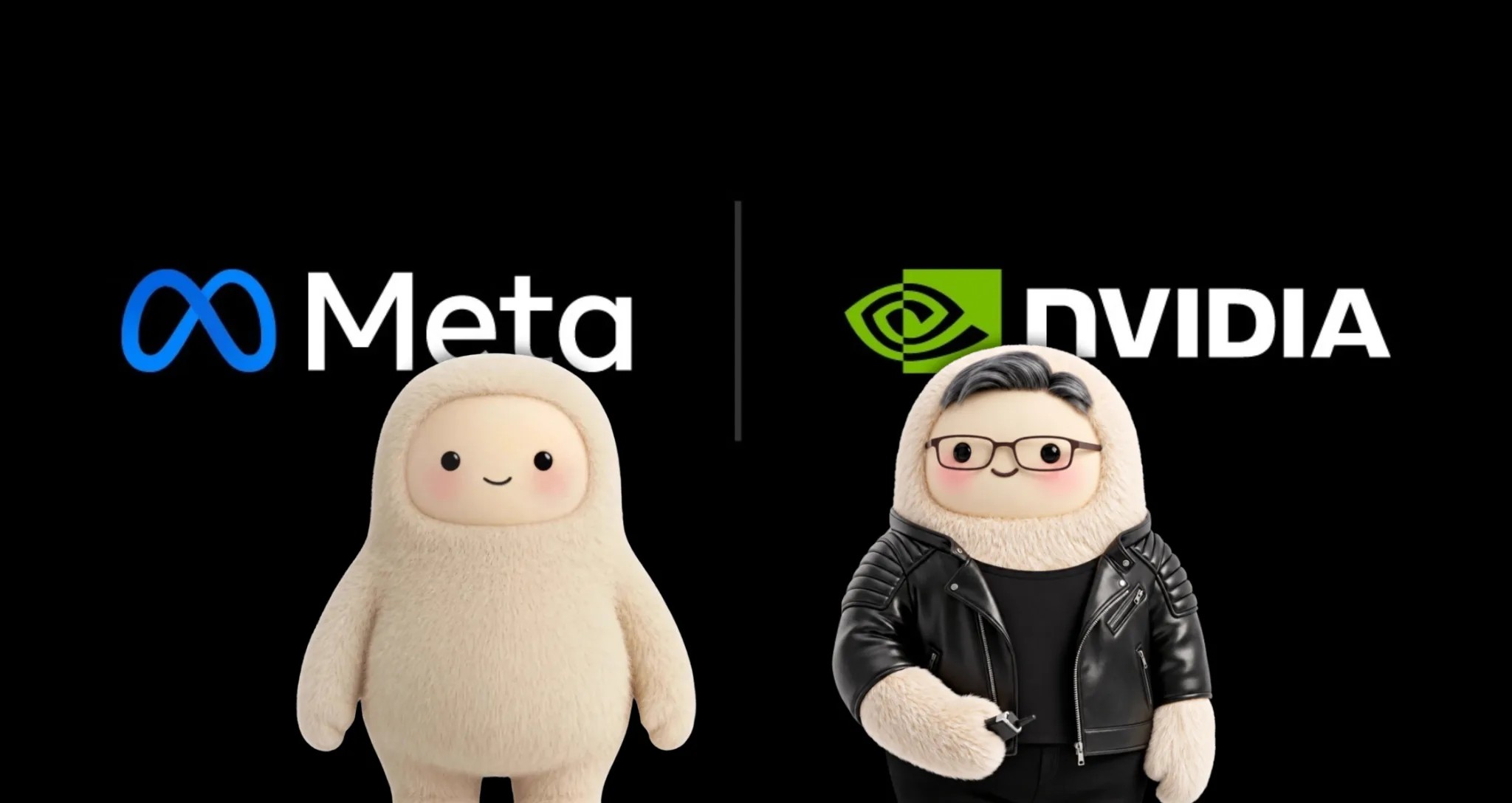
Friends, $3 billion is no pocket change. NVIDIA has seen plenty of big moments over the years — so what kind of project makes Jensen Huang put up real money and show up in person to pitch it?
The answer comes down to two words: AI agents.
What Exactly Is Muse
Let's break down the jargon first. Muse is Meta's family of AI models and agents, and it has run on NVIDIA infrastructure from day one.
The report card isn't bad. Since launch, it has posted frontier-level results across multiple benchmarks, while downloads keep climbing.
Here's how I evaluate projects: is it a lab exhibit or a real product? Muse is clearly the latter — the market has already voted. When NVIDIA writes a check, it's buying certainty.
The Money Is Just the Ticket; the Real Goods Are in the Partnership Details
Many people saw the headline and assumed this was just a financial investment. But after reading the official press release, I found the valuable part is in the cooperation details.
The most concrete layer is end-to-end optimization. The two companies will tune Muse's training and inference workflows — pushing performance up while driving costs down. In plain terms: make the AI employee work faster, on a smaller power bill.
Digging deeper, there's the safety infrastructure. The companies are discussing collaboration built on the "NVIDIA OpenShell" reference architecture — OpenShell handles safe agent deployment, while NVIDIA Sentry watches agent behavior. It doesn't sound glamorous, but it's the most critical piece. Would you trust an autonomously running AI to make decisions for you? Without a safety layer underneath, agents stay toys forever.
Finally, compute upgrades. Meta will deploy NVIDIA's Vera Rubin GPUs and Vera CPUs at scale for next-generation AI agents, paired with Spectrum-X Ethernet and BlueField-4 DPUs. This combo chase one goal: squeeze maximum performance out of every watt.
Why Now
There's a line in Jensen Huang's statement worth reading word by word: "AI agents represent a new computing paradigm — software that understands our goals, reasons, uses tools and gets work done on our behalf."
The phrasing is polite, but the message is hard: the way we use computers is about to change. It used to be humans operating applications; going forward, humans will work alongside agents.
Look back at history, and every computing era had a battle over the ecosystem's prime seat. In the PC era, Microsoft ruled through the operating system. In the mobile era, Apple and Google split the world through app ecosystems. In the agent era, that chair is still empty.
Zuckerberg's framing is blunt: Muse is how we bring personal superintelligence to everyone. Meta has poured nearly a hundred billion dollars into Reality Labs and taken plenty of mockery for it. But connect this investment with the financials, and Meta's playbook hasn't changed — it doesn't want to sell glasses; it wants everyone to have an AI twin by their side.
NVIDIA is even more comfortable. Whichever agent wins, it crosses the river on NVIDIA's compute.
The Detective's Take
The $3 billion looks like an investment on the surface, but it's really picking a side. Two giants are betting on the same judgment: agents are the entry point to next-generation computing.
For ordinary people, the change won't arrive as a keynote — it creeps in. One day you'll notice that booking flights, writing reports, and tracking projects have quietly been handed to a digital colleague who is more reliable than you and doesn't draw a salary.
The question isn't when AI will replace people. It's this: when everyone owns a superintelligent twin, what do you plan to do with yours?
References:
分享文章
3篇相关文章
Meta's AI Glasses Dilemma: When Your Glasses Know You Better Than Yourself, Should the Privacy Light Be On?
2026-07-30
When your glasses know you better than you know yourself, do you have a more convenient life, or deprived privacy?
Chinese AI Glasses Company Becomes Unicorn: What Does This Signal?
2026-07-09
Chinese smart glasses company Even Realities secured $150 million in funding, reaching a $1 billion valuation to become a unicorn. Led by Meituan and Tencent.
The 'Steam Engine Moment' for 3D Content Production: VAST Raised 1 Billion RMB
2026-07-02
When giants like Geely, Giant Network, and 4399 all bet on a 3D AI model startup, I think this signals something meaningful.