The 'Translator' for Robot Learning: DPVR Makes VR the Data Entry for Embodied AI
Embodied AI is moving from single-point demonstrations to real-world task training.
But a key problem is overlooked by most: for robots to complete tasks like grasping, moving, sorting, pouring water, opening doors, they need not only to see the environment but also to understand how actions happen, how to adjust, and how tasks are completed.
Robots Don't Need Videos
Many people think feeding robots enough videos is enough.
Dead wrong.
Take "grabbing a cup" as an example. The robot not only needs to know that a cup appears in the frame, but also where the operator's hand starts moving, how to approach the cup, what pose the end-effector uses to approach the target, when the gripper closes, whether the cup is held stably, and whether the task is completed successfully.
With only a video segment, it's difficult for models to accurately understand the spatial relationships and control logic behind actions.
Robots need multimodal operational data aligned with action, space, state, and results.
This requires a "translator" to translate human spatial operations into training data robots can understand.
Why VR is the Best "Translator"
DPVR is solving this challenge with PCVR technology.
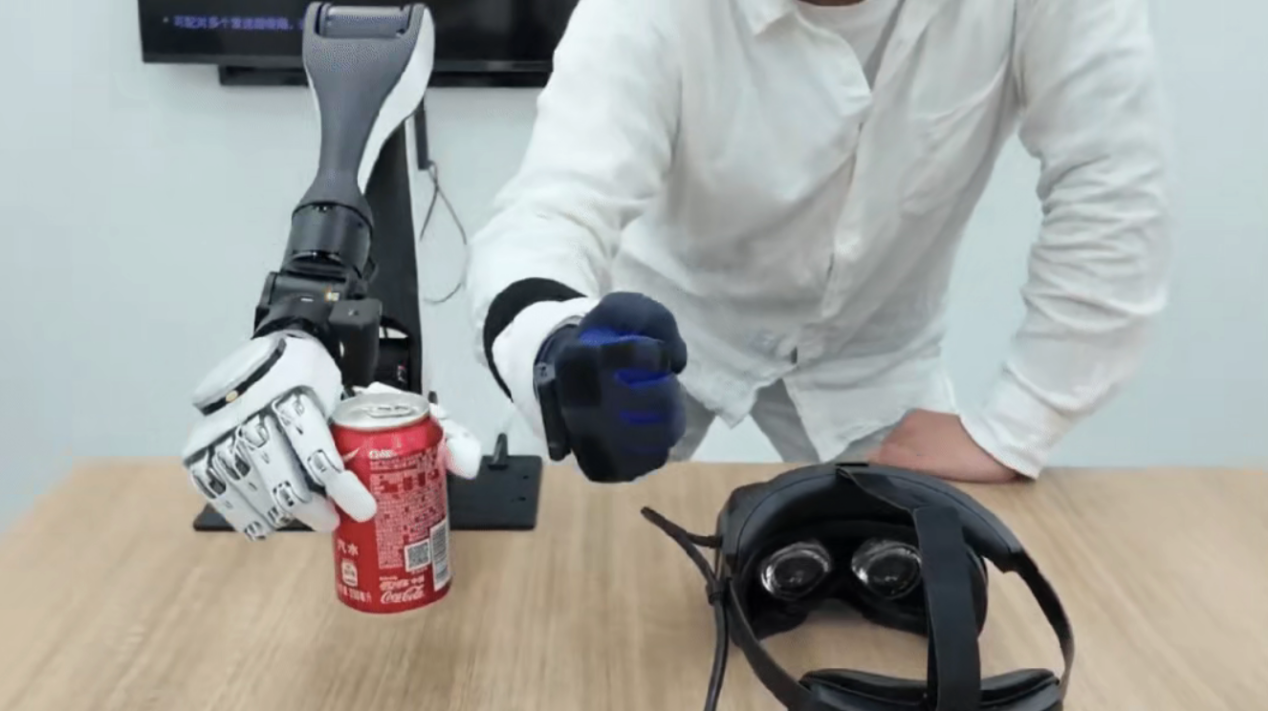
Compared to keyboard/mouse, joysticks, or 2D screen controls, VR headsets and interaction devices allow operators to perceive task environments in a way closer to real operations and complete spatial input through head and hand actions.
This interaction method is better suited to express spatial operation intentions and allows human operation trajectories to be recorded more naturally.
More importantly, based on PCVR systems, RoboPilot can continuously record head pose, viewing direction, two-hand/controller pose, spatial motion trajectories, and control commands around operator behavior, combining them with robot feedback images, robotic arm joint states, gripper opening/closing states, and task results to form multimodal data for robot training and task review.
This data must be aligned on the same timeline. Images, actions, poses, robot states, and task results need to be synchronized, otherwise the collected data's training value will be greatly reduced.
RoboPilot's Positioning
DPVR RoboPilot is not a robot body, nor does it replace robot control systems or model training platforms.
Its core value is serving as the spatial interaction and data collection entry point at the front end of the embodied AI training chain, connecting human operation processes with robot execution processes.
In practical applications, RoboPilot can serve three core needs:
First, help customers quickly build robot teleoperation verification environments. Operators can control robotic arms, dexterous hands, or robot platforms through DPVR headsets and interaction devices to complete task verification like grasping, transporting, placing, and sorting.
Second, synchronously accumulate operator actions, robot states, and task results during teleoperation, providing basic data for subsequent imitation learning, VLA model training, and strategy optimization.
Third, support task review and system optimization. R&D teams can analyze operation process records to determine if problems appear in visual recognition, motion planning, control latency, gripper force, or task strategy levels, thereby continuously optimizing robot systems.
Lowering Barriers
Current robot teleoperation and data collection solutions often involve complex motion capture equipment, exoskeleton systems, custom control platforms, and multi-sensor integration, with relatively high overall deployment costs and longer cycles.
RoboPilot, based on DPVR's mature PCVR hardware and spatial interaction technology, can help robot companies, university research institutions, embodied algorithm teams, and industry customers build robot teleoperation and motion data collection verification environments at lower costs and shorter cycles.
PCVR architecture can rely on PC computing power and stable connection capabilities to provide more reliable low-latency interaction foundations for robot teleoperation. For tasks like robot grasping, sorting, and transporting, low latency not only affects operation experience but also affects trajectory continuity, task success rates, and data stability.
From Virtual Reality to Embodied AI
From virtual reality to robot spatial interaction, from head-hand tracking to motion data collection, from PCVR hardware to embodied AI training scenarios, RoboPilot represents the extension of DPVR's long-term technical capabilities in new industry chains.
In the future, for robots to truly learn to complete tasks in the real world, they need to continuously understand how humans operate, judge, and correct actions.
DPVR RoboPilot is exploring the connection between human operation and robot learning.
From remote control to data accumulation, RoboPilot is making every human operation a training sample for robots to learn the real world.
When robots finally learn to operate like humans, are we ready to face a truly intelligent future?
分享文章
3篇相关文章
Meta's AI Glasses Dilemma: When Your Glasses Know You Better Than Yourself, Should the Privacy Light Be On?
2026-07-30
When your glasses know you better than you know yourself, do you have a more convenient life, or deprived privacy?
Chinese AI Glasses Company Becomes Unicorn: What Does This Signal?
2026-07-09
Chinese smart glasses company Even Realities secured $150 million in funding, reaching a $1 billion valuation to become a unicorn. Led by Meituan and Tencent.
The 'Steam Engine Moment' for 3D Content Production: VAST Raised 1 Billion RMB
2026-07-02
When giants like Geely, Giant Network, and 4399 all bet on a 3D AI model startup, I think this signals something meaningful.